Measurement of host-guest binding constants is one of the pillars of supramolecular chemistry and is indispensable for designing smart materials, chemo-sensors, etc. Up to now such measurements are typically made by methods that give absolute binding constant values, but at the same time suffer from serious systematic effects making comparison of data from different research groups very difficult.
Kristjan has developed an approach for accurate and comparable measurement of host-guest binding affinities whereby differences in binding strength (ΔlogKass values) are measured between two host molecules toward a particular guest under identical solvent conditions. Measuring differences instead of absolute values enables obtaining highly accurate results, because many of the uncertainty sources (the solvation/association state of the guest in solution, deviations in solvent composition, etc.) cancel out. As a proof of concept, this method was applied to the measurement of the binding strength of 28 synthetic anion receptors toward acetate in acetonitrile containing 0.5% water. The receptors included differently substituted indolocarbazoles, ureas, thioureas, and some others. A self-consistent (consistency standard deviation 0.04 log units) binding affinity scale (right) ranging for around 2.7 log units was constructed from the results.
This work – published in an organic chemistry journal and belonging to the field of supramolecular chemistry – is a nice demonstration of the ubiquity of importance of reliable measurements.
On Friday, Aug 30, 2013, the introductory meeting for first-year AMS students was held. Sergei Jurtšenko gave overview of the AMS programme, timetable of autumn semester 2013 and some practical aspects of studying in Tartu. The PDF file of this presentation is available for download from here.
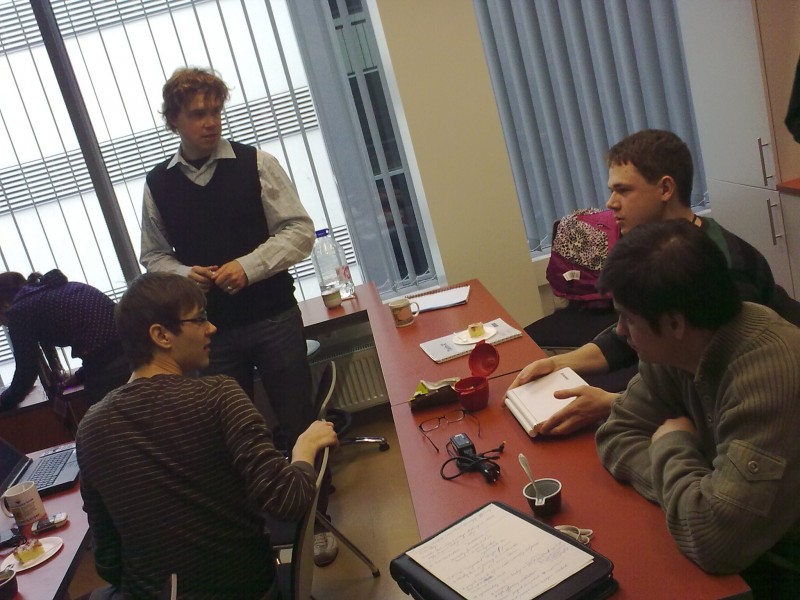
Roland Hoxha (in the middle on the photo), an AMS student who participated in the Measurement Science in Chemistry (MSC) Summer shool 2013 in Lyon said the following about this experience:
“Summer school was really a great experience for me. Meeting new friends, sharing knowledge between each other, playing games, visiting marvelous places and furthermore learning chemistry. Even though Measurement science in chemistry (MSC) at Tartu University is a completed program in metrology in chemistry, summer school decorated it with its surprises by teaching new things in a quite interesting and amusing way. I really consider myself lucky for participating in MSC summer school. I wish that every student who study metrology in chemistry to try it.”
Shanshan Wu (third from left on the photo), an AMS student who participated in the Measurement Science in Chemistry (MSC) Summer shool 2013 in Lyon said the following about this experience:
“This is an unforgettable Summer I never had before, full of new things and challenges. This Summer school not only let me enhance my knowledge and skills but also broaden my views. Thank you for everyone who offered me this chance to take part in it!”.
The next MSC Summer school is scheduled to take place in Pulawy (Poland) in Summer 2014. All students enrolled in the Applied Measurement Science programme are eligible for applying for membership in the MSC consortium and in the Summer school.
On Friday, Jul 12, 2013 the MSC Summer school visited the Alps and ascended from Chamonix to a nearby mountain – Aiguille du Midi – with the height of slightly over 3800 m. This is a big advancement from the previous “MSC Summer school record” – Mount Moussala, the highest top of Balkans at 2925 m – which was conquered during the 2009 MSC Summer school.
The picture on the left gives some impressions from Aiguille du Midi. The highest top on the picture (the white round one on the right) is the Mont Blanc. In addition to enjoying the fantastic views and a walk in the mountains, numerous water samples were collected by the students. Those water samples will be analysed in the coming week and compared to the ones taken from various places in Lyon.
Two young scientists – Karin Kipper and Riin Rebane – from UT analytical chemistry research group participated in the recent HPLC2013 conference in Amsterdam. Both of them presented the most recent results of their work.
The presentation of Karin Kipper (left) titled “Simultaneous Analysis of Carbapenems in Human Bodily Liquids Using HFIP as Buffer Additive in LC-ESI-MS/MS” focuses on the use of 1,1,1,3,3,3-hexafluoroisopropanol (HFIP) as a weak volatile buffer acid for creating LC/ESI/MS mobile phases in the basic range (pH = 8 .. 10). It is not easy to find a good buffering system in this pH region that would at the same time be LC/MS compatible, that is, volatile and not suppressing inonization. HFIP, when mixed with ammonia, offers such possibility. Besides providing suitable buffering capacity at high pH HFIP as mobile phase component also increases the retention of compounds poorly retained on the C18 mobile phase and improves peak shape.
Riin Rebane (right) in her presentation “Method development strategy for derivatization LC/ESI/MS” explores the derivatizing agents for amino acids for LC/ESI/MS analysis. Amino acids generally cannot be analyzed by LC/ESI/MS without derivatization, because they are highly polar (zwitterionic) compounds and (1) are poorly separated on most stationary phases and (2) are (paradoxically!) poorly ionized in the ESI ion source. Riin has explored both classical (Fmoc-Cl, DNS, DEEMM) and novel (TAHS, FOSF) derivatization reagents. She discovered that the novel derivatization reagents proved to be more sensitive and the FOSF reagent (developed ans synthesized in her work) offered better chromatographic separation than TAHS. Moreover, with careful method development towards LC/ESI/MS analysis, classical reagent DEEMM can provide comparable detection to novel reagents with advantages such as good chromatographic separation and wide linear range.
On July 08, 2013 the sixth MSC Euromaster Summer School 2013 started in Lyon (France). Altogether 34 students from more than ten countries participate in the Summer school, among them three students from the AMS programme of University of Tartu: Astrid Pung, Shanshan Wu and Roland Hoxha. The activities in the summer school put large emphasis on interactive learning, problem solving and team work. Please see the MSC Consortium website for more information.
Around 70% of industries use drying at some stage of their production process. Active ingredients in pharmaceuticals, carbon-fibre composites, polymers, food powders, novel cellulose-based active paper, biomass and in many other solid materials are highly affected by moisture when processing into various products. Errors and inconsistencies in moisture measurement and control in industrial processes lead to decreased process speed/throughput and increased wastage, shortened durability of biomaterials, increased energy consumption in drying and increased fine particle emissions in biomass combustion.
Currently more than 1300 national or international documentary standards are in active use because available measurement methods, reference methods and even the current definitions for moisture as a measurand are material specific. Moisture also is a tricky parameter to measure – moisture is everywhere around us, water can be bound in materials with different strength, etc. These effects escalate in calibrations of moisture analysers with reference samples. The measurement uncertainty is usually substantial, but in many cases unknown.
This international project – SIB64 METefnet – with partners from Finland, UK, Estonia, France, Romania, Czech, Italy, Denmark, Turkey and Slovenia aims at a radical movement away from the standards/procedures-based metrology and towards improved dissemination of SI traceability to moisture measurements in industry by removing ambiguities and inconsistencies in moisture measurement and calibration techniques. This will be achieved through development of new more relevant and effective methods of realising and disseminating SI units of moisture and provision of metrology infrastructure for moisture measurements.
University of Tartu participates in METefnet and is responsible for setting up high-level primary coulometric KF titration measurement method of moisture in different materials.
The full summary of the project can be seen at its (still embryonic) website: http://www.metef.net/
The EMRP is jointly funded by the EMRP participating countries within EURAMET and the European Union.
Ten AMS master’s students successfully defended their theses today (on June 10, 2013). On picture, from left: Hedi Sinijärv, Sander Sannik, Karen Atabekjan, Yingjian Hou, Kristjan Haav, Kamarniso Vrandecic, Pippa Hayes, Agnes Ivanov, Galyna Gryliuk, Agnes Suu.
Traditionally for AMS the topics of the theses were diverse ranging from nuclear energetics to measurements in biochemistry and from synthetic molecylar receptors to redefining the concept of pH.
Definitions of the International vocabulary of metrology (VIM 3) are the foundation of the language spoken by measurement people. The definitions have been carefully elaborated with the involvementof a number of top experts. Nevertheless, if a near-perfect definition is aimed at then it often happens that the definition becomes complex and loses its simplicity. So, some of the definitions need additional explanations to be fully understood, especially by students and people at routine laboratories. One of these is the VIM definition of calibration, especially if it is to be applied to the instrumental chemical analysis.
The ESTCube-1 satellite was successfully launched early in the morning of 07.05.2013! Some hours later on the same day it was officially announced that the satellite works. Three AMS students (Kaspars Laizans, Martynas Pelakauskas, Mykola Tverdokhlib) are participating or have participated in the project. See more at the ESTCube-1 Facebook page.
Hydrogen bond (HB) is by its importance a unique chemical phenomenon in nature and has been widely studied from almost any possible viewpoint. HBs have an enormous role in the structure (proteins, nucleic acids, cellulose fibers, etc) and functionality (enzyme catalysis, ligand-receptor complexes, etc) of all forms of life as well as a countless number of supramolecular systems. Computational prediction of HB is of high interest both for rationalizing existing and developing new chemical and biochemical systems and processes. A comprehensive study of modeling HB with the COSMO-RS computational method has been recently carried out at UT Chair of analytical chemistry (ChemPhysChem, 2013, 14). The method displayed mixed behavior, being quite successful with some systems but failing with others.
Q: What is the connection here with measurements?
A: A direct one. The level of success of the computations was assessed by comparison with measurement results of hydrogen bond formation equilibrium constants. And, surprisingly, it turned out that a large part of data on HB formation constants in the literature was unusable because of inconsistrencies and lack of any information characterizing the uncertainty of the values. The values from different groups sometimes varied by up to an order of magnitude (!). Such doubtful datasets of course were left aside when carrying out the evaluation.
This work nicely proves the importance of good measurement science also for theoretical chemistry: it is not possible to develop and improve theoretical computation methods if teh obtained results cannot be compared to accurate measurement results.
An important direction in making measurement instruments is making them simpler, cheaper and accessible to many people. An interesting development in this direction has been made at SYKE (the Finland Environmental Administration): the Secchi3000 Turbidity analyser, in which a standard mobile phone camera serves as the measurement instrument.
Secchi3000 was developed to be a low cost and simple operation tool for water quality measurements. The objective was to offer it also for non-experts and citizens interested in water quality issues. Performing measurement with Secchi 3000 is simple: The user fills the Secchi3000 container with water from a lake, river or sea, places the measurement structure in the container and takes a photograph with a mobile phone through a hole in the lid of the device (Figure on the right). The photograph is taken with an application called EnviObserver (developed by VTT, Finland). The application sends the photograph to a server together with metadata such as the location of the measurement. At the server the photograph is analysed with an algorithm, which finds the target areas from the picture and computes water quality parameters based on the brightness values of the target areas. Finally, the results are sent back to the user’s mobile phone and stored in data bases.
During 17-22.02.2013 The first Analytical Chemistry Winter school “Novel analysis methods”, organized by the St. Petersburg’s State University, took place near St. Petersburg (Russia). Ivo Leito participated in the event and gave a short lecture about Liquid chromatography tandem mass spectrometry with the electrospray ion source (LC-ESI-MS/MS) as a tool in trace contaminant analysis. The lecture presented the difficulties in connecting LC to MS, described electrospray (ESI) ion source as the most widely used intrerface for connecting LC and MS, briefly explained the multidimensional information obtainable from LC-MS experiment and finally reviewed the benefits of tandem mass spectrometry (MSMS or MS2) detection in trace contaminant analysis as opposed to simple MS detection.
Amer Jamil Aref Al-Malahmeh from Jordan successfully defended his master thesis on January 15, 2013. The title of the thesis was “Methodological development and validation of Sample treatment and Source preparation procedures and Liquid Scintillation counting measurements for Determination of 226Ra in Drinking water”. 226Ra is a potentially dangerous radionuclide for people using ground water as drinking water. A large number of different influencing factors were tested and evaluated in the thesis and a serious uncertainty budget was compiled, which can be of high interest to scientists working in the area of radionuclide determination. The thesis is remarkable also because it was defended four months (!) in advance of the deadline.
On Saturday, Dec 15, 2012, the Autumn semester master’s seminar 2012 of the AMS programme was concluded with presentations from students.
Most of the presentations were based on the master’s thesis topics of our students. As is typical for our interdisciplinary programme, the topics were diverse, ranging from determination of radium in water to artificial molecular receptors, from universal pH scale to building a student satellite. Here is a short (and not exhaustive) list of the areas in which our students do their master’s projects: _END_
Validation of analysis metod or Radium 226 in water
Study of Excitonic Energy Level Structure in Photosynthetic Antenna Complexes
Experimental realization of the generalized definition of pH value (so-called unified pH scale)
Measurement of the binding efficincy of synthetic molectlar receptors towards analytes of environmental and health concern
Developing an ATR-FT-IR-based procedure for quantitative analysis of materials usage in works of art
Should you have interest in any of these (or other) topics you are welcome to contact Ivo Leito.
Before the seminar, a questionnaire (anonymous) was distributed to the students addressing the AMS programme. The questions were about the usefulness of the programme in finding a job related to measurements or chemical analysis, about the general organization of the programme, quality of teaching, etc. The presentations were followed by a discussion of the responses. Many constructive comments and suggestions for improvements were received from the students.
It is very pleasant, however, that the overall evaluation of the programme by the students was very high, both in terms of the quality of teaching and in terms of competitiveness of the graduates on the job market.
Liquid chromatographic separation of basic analytes is often hampered by problems, such as insufficient retention, wide and asymmetric peaks, etc, especially if carried out at acidic pH. Many modern HPLC coulmns can stand pH values up to 10 without problems and separation at a higher pH is often a good approach for liquid chromatographic separation of basic analytes, such as different amines. Unfortunately, the choice of buffer systems in the range of pH 7-10 suitable for LC/ESI/MS work is very limited. The main requirement for the electrospray ionization mass spectrometry is that besides suitable pH all the components of the buffer system should be volatile. This immediately excludes phosphate, carbonate, borate, etc buffers. On the other hand, the buffer should not compete with the analytes in the electrospray ionization process. This excludes most organic bases. The ammonia/ammonium acetate or ammonia/ammonium formiate buffers are the most used ones. Nevertheless, also use of these buffers and mobile phase pf pH aroun 9 often results in less than ideal separation and peak shape. Thus new LC/MS-compatible volatile buffer systems would be highly welcome.
Karin Kipper from UT Institute of Chemistry has made a significant contribution in this field by introducing two new buffer compounds, two fluoroalcohols – 1,1,1,3,3,3-hexafluoro-2-propanol (HFIP) and 1,1,1,3,3,3-hexafluoro-2-methyl-2-propanol (HFTB) (Journal of Chromatography A,2011, 1218, 8175–8180). She has found that these compounds offer interesting possibilities to adjust retention behavior of different analytes by using high pH values (ammonia is used for pH adjustment) and expand the currently rather limited range of ESI-compatible buffer systems for basic mobile phases. Good separation of different compounds was observed with excellent peak shape. The fluoroalcohols did not suppress the ionization of the analytes in the electrospray source and for several analytes ionization enhancement was observed. Thus, these compounds are suitable for electrospray mass spectrometry.
All trends in retention of the acidic and basic analytes can be interpreted by the following model: the neutral fluoroalcohols are quite strongly retained by the stationary phase whereas their anions are less retained, thus their amount on the stationary phase is dependent on mobile phase pH; the anions of the fluoroalcohols form ion pairs in the mobile phase with the basic analytes; the fluoroalcohols on the stationary phase surface compete with acidic analytes thereby hindering their retention; the fluoroalcohols on the stationary phase bind basic analytes thereby favoring their retention.
The suitability of these fluoroalcohols as buffer components for LC/ESI/MS analysis has been verified on the example of simple organic compounds (bases, such as amines, pyridines, anilines) as well as several antibiotics – three fluoroquinolones: ciprofloxacin, norfloxacin, ofloxacin; and two sulfonamides: sulfadimethoxine, sulfamethoxazole (Analyst, 2011, 136, 4587–4594).
We hope that this novel approach will eventually gain popularity and we welcome any feedback on its practical use.
A new software package for measurement uncertainty calculation called MUkit (shortcut from: Measurement Uncertainty kit) has been recently made available by SYKE, the Finnish Environmental Administration. This is the first software package that offers direct support for laboratories in measurement uncertainty evaluation according to the increasingly popular Nordtest approach of measurement uncertainty estimation.
Electrospray ion source (ESI) is the most used ion source type for connecting liquid chromatography (LC) with mass spectrometry (MS) due to its robustness and possibility to analyze a wide range of analytes. LC/MS in turn is currently the most used analytical technique for determining trace contaminants (pesticides, mycotoxins, drug residues, …) in the widest possible range of matrices (water, food, blood, …)
ESI is a very good LC/MS ion source but it still has two major shortcomings. Firstly, ESI is in general not efficient in generating gas-phase ions (meaning, the large majority of the analyte molecules pass the ion source without being detected). Secondly, ESI is susceptible to the so-called matrix effect – decrease of the analyte response in the presence of compounds co-eluting with the analyte. These drawbacks lead to lowering the sensitivity and increase of the risk of possible false-negative results.
Anneli Kruve from UT Chair of Analytical Chemistry has come up with an original idea how to improve the sensitivity of an ESI source and make it less susceptible to the matrix effects. The essence of the idea is to modify the nebulizer (the key component of an ESI source) by adding an additional capillary directing the nebulization gas right into the stream of solution (the thin innermost capillary on the image). The prototype of this ion source has been built (see the image) and experiments have shown that this design offers significantly enhanced ionization efficiency compared with the classic nebulizer design and leads to improved sensitivity (by three to 10 times) and decreases the detection limit, on an average 10 times. The patent application of this development has been filed and a communication has been published in J. Am. Soc. Mass Spectrom. (2012).
Recent studies have shown that the matrix effect in the ESI source mostly arises from the competition of ionized analytes and matrix compounds for the droplet surface. It is expected that by more effective nebulization the net surface area of the droplets increases and thus the competition decreases leading to decrease or elimination of the matrix effect. Testing of this hypothesis is currently in progress.
The gain in ESI sensitivity may open up new horizons in different fields of LC/ESI/MS application. It may become possible to detect different marker molecules at very low levels in complex biological matrixes in biochemical and medical analysis, possibly leading to e.g. early discovery of diseases; it may become possible to determine the background concentrations of organic pollutants in environment, which is very important for understanding and modeling their behavior in the environment; etc.
On August 31, 2012 Irja Helm successfully defended her PhD Thesis High accuracy gravimetric Winkler method for determination of dissolved oxygen at Institute of Chemistry, University of Tartu. The essence of the work is development of a highly accurate gavimetric Winkler titration procedure for determination of dissolved oxygen content in calibration medium for optical and amperometric dissolved oxygen sensors.
Dissolved oxygen (DO) content in natural waters is a very important parameter. Recent studies show decrease in DO content in several areas of world oceans. Processes leading to this decrease are not completely understood and it is very important to be able to measure DO content very accurately for studying the dynamics of these processes. Amperometric and more recently also optical oxygen sensors are widely used in DO measurements. These sensors need calibration and therefore solutions with accurate DO concentration are necessary. And this is where Irja’s method will be very useful.
On 31.08.2012 the introductory meeting for first-year AMS students was held. Sergei Jurtšenko gave overview of the AMS programme, timetable of autumn semester 2012 and some practical aspects of living and studying in Tartu. The PDF file of this presentation is available for download from here.
Klodian Dhoska, graduated from AMS in 2010 shared his thoughts about how the programme has influenced his life during the last two years:
“Experience at Applied Measurement Programme has given to me a very good career. I am technical expert at Albanian Accreditation Directory, Head at Mechatronics Department on private University in Tirana, part-time lecturer at Polytechnic University of Tirana and in the end I am accepted as a full time doctoral student at Tallinn University of Technology. You don’t need to search for a good career because the career is following a succesful AMS programme at University of Tartu.”
The MSC Summer school finished on Jul 27, 2012. Kristjan Haav, one of the participants (from the AMS programme, University of Tartu) shared his impressions.
Ivo: What would you single out as the top experiences in the summer school?
Kristjan: From the professional viewpoint it was the experience of being the leader of our team “Magus Jook Laboratory” in the Student contest. I was elected leader by our group because it turned out that I had somewhat deeper knowledge about analytical chemistry than my groupmates. I had no similar leadership experience prior to the summer school and managing the work of an international group was quite a challenge. Eventually it worked out quite well – our team got 24 points out of 25 for the student contest. From entertainment point of view the top experience was certainly the surfing day on the ocean coast.
Ivo: OK! So, I understand that the knowledge and skills that you have obtained from the first year of AMS were sufficient for participating in the Summer school?
Kristjan: Yes. It was actually quite pleasant realize how many valuable things we have learned.
Ivo: What is your overall impression of the summer school?
Kristjan: It was much more challenging and exhaustive than I thought. It was two weeks of serious studying, both in theory and in practice. And it is not over yet – we still have homework to complete. I would say that especially the practical assignments at the Summer school were very interesting and useful. _
As a nice counterbalance to the serious and challenging programme of the summer school last weekend there was a surfing outing at the summer school.
All participants had the possibility to try surfing in the Atlantic Ocean under the guidance of professional instructors. It seems that they had a lot of fun!
On Monday, July 16, 2012 the fifth Measurement Science in Chemistry International Summer School started in Fatima (Portugal). In this edition, 48 students from thirteen countries participate. The dense and challenging programme will give the students opportunities to learn and practice almost every metrological aspect of analytical chemistry.
Topics, such as Validation of chemical analysis procedures, Statistical basis of calibration, Traceability in chemical analysis, Measurement Uncertainty, including the Alternative Approaches for the Quantification of Measurement Uncertainty, ISO 17025, Sampling and sample preparation in food and environmental analysis, Customer-analyst interactions are included in the programme.
Efforts are made to make the summer school more interactive (as opposed to listening to lectures). This is done via the student contest/game, accreditation visit to a real lab and numerous group work sessions.
The thesis was awarded the highest mark “A”. Alda talks about the thesis: “I prepared my master’s thesis in the organic chemistry field. The main goal of my work was to find out the best synthesis scheme to synthesize as pure as possible stereoisomers of 2,2,5-trisubstituted tetrahydrofurans. Main goal was achieved, 98% enantiomerically pure 2,2,5-THF enantiomer was synthesized”.
Here are some of Alda’s comments about University of Tartu and the AMS programme:
University of Tartu provided me with rich knowledge in theoretical and practical base. We had lots of practical trainings and interesting and useful information in lectures. And it was very useful that some information was overlapping between lectures – great possibility to repeat material.
During study time I was working in the UT Institute of Technology in organic chemistry laboratory. And I would like to thank PhD Lauri Vares for accepting me in his research group. During master’s thesis work up time I was supervised by Ilme Liblikas, the best supervisor I ever had. Thank You, Ilme!
Leaving University of Tartu with master’s degree in my pocket I feel much richer – I had a great opportunity to study in international programme, improve my English and make lots of new friends from different countries all over the world.
I would like to thank prof. Ivo Leito for being such a great leader, and University of Tartu over all for hosting me.
In the future I am definitely planning to use my knowledge in Chemistry and Applied Measurement Science. And probably at some point I will get PhD.
Hanno Evard defended his master thesis on June 11, 2012. The title of the thesis was “Study of paperspray ionization and its possible applications”.
The thesis was awarded the highest mark “A”. Hanno talks about the thesis: “My master thesis topic was about studying a new ionization method for mass spectrometry – Paperspray Ionization. In the course of the study I got the possibility to work with different mass spectrometers including an FT ICR mass spectrometer. As it was the first time in University of Tartu to study this ionization method the work was very complicated. However with the help of my supervisor and other staff in the Chair of Analytical Chemistry the working was easy and fun. I found in the course of the thesis that the new method can be used to obtain information about composition of papers and to identify pesticides from citrus fruits bought from a supermarket. I will be working further with Paperspray Ionization in the course of my doctoral studies”.
Here are some of Hanno’s comments about University of Tartu and the AMS programme:
The past two years while studying in the Applied Measurement Science programme have been very interesting and fun. University of Tartu gives a wide field of education and strong practical experience on the studied subject. The teachers are friendly and ready to help with any problems that students might have. Moreover they are at the top of their fields and therefore the most qualified to teach the subjects. The laboratories and lecture halls are new and well equipped. Students have the possibility to use and study complex and expensive equipment. The programme gives you a good opportunity to meet people from all around the world.
On May 21-22, 2012 a workshop Validation, Traceability, Measurement Uncertainty: the Challenges for the 21th Century Analysts took place in Berlin. This workshop focused on the relationship between method validation, traceability and measurement uncertainty in various fields of quantitative analytical measurements. In addition to lectures there were two workshop sessions devoted to discussions about the practical problems of validation of analytical procedures, establishing and demonstrating traceability and estimating measurement uncertainty.
On March 23, 2012 an in situ interlaboratory comparison measurement of dissolved oxygen concentration EstDO-2012 was carried out at the Testing Centre of University of Tartu. Altogether 13 participants from Estonia (different institutions), Germany (IO Warnemünde), France (IFREMER) and Finland (SYKE) took part in the intercomparison. The participants used amperometric and optical (fluorescence quenching) sensors.
There is a perception that measurement of dissolved oxygen concentration is simple. In reality it is not. Dissolved oxygen is an unstable analyte and its determination is affected by numerous uncertainty sources (a comprehensive overview of the uncertainty sources of amperometric dissolved oxygen sensors and ways of taking them into account is given in a recent review: Sensors2010, 10, 4430-4455, open access). Therefore such comparisons between laboratories are essential for improving the quality of measurements made by laboratories.
In situ intercomparisons are organized in such a way that all participants gather in the same place and make measurements on the same object. The “object” in this case was a basin of water with carefully controlled dissolved oxygen content. The basin was immersed in a themostat for temperature control and the water was stirred because the readings of the amperometric sensors depend on stirring. The sensors of the participants were arranged concentrically to allow similar intensity of water movement in the vicinity of the sensors. Picture on the right shows the basin and the sensors.
Organization of this intercomparison has been partly funded by the European Metrology Research Programme (EMRP), project ENV05 “Metrology for ocean salinity and acidity”. The EMRP is jointly funded by the EMRP participating countries within EURAMET
and the European Union.
The lectures triggered interesting discussions. The students wanted to know about the limits of modern analytical chemistry, about the possible uses of superacids, about the consequences of wrong measurement results. The joint residual message of the lectures was that accurate and reliable measurements (and chemical analyses) are one of the foundations hire Inflatable Bounce of modern science and technology and with their development the importance of accurate measurements is going to increase.
This visit is expected to be the start of a fruitful collaboration between USST and UT. The visit was organized in the framework of and with funding from the Study in Estonia cooperation platform. _
text by: Iuliia Demchuk
Portugal… You will hardly find a person who doesn’t like it! This country is charming and most probably you will fall in love with it from the very first sight. Like it happened to me . Although I lived in Lisbon only, that city made a wonderful impression about the whole country 😉
First of all, the nature! It’s just amazing! There are palm trees everywhere and the sun is shining all the days long. So, there are millions of options what to do at you free time : go for a walk, go off the beach and do surfing, or just simply stroll in the city center.
When the weather is not so good ( which happens rarely), Lisbon can offer you many interesting museums, exhibitions and places of interest.
There are also many bars, pubs, clubs, shops , malls, bla bla bla…
However the most wonderful thing for me was local architecture – it is completely different from everything that you can find in Europe. Lisbon has its own style, which was influenced by African colonies and closeness to the ocean. So each time you hang out in the city center, you will always find something new and charming.
But the most important thing and the main aim of my trip were studies and international experience. And I’m 100 % satisfied that I chose University of Lisbon for this purpose. Professors at the department of chemistry ( especially Ricardo Silva, Maria Filomena Camoes – thank you again for everything!!!!!) are highly qualified and professional teachers. On the other hand, they are the most welcoming, friendly and cooperative teachers that I’ve ever met. They are always glad to help you – with your studies, with courses selection or even with everyday affairs.
During my Erasmus semester in Lisbon, I was studying a subject called “Quality in Analytical Chemistry” and doing a project “Assessment of the metrological performance of the identification and quantification of food dyes in aqueous solutions”. About the subject – it was very interesting, and it is practically very important for people dealing with measurements and analytical chemistry. It gives a deep and very detailed overview about development an validation of the analytical procedures, and I can personally say that I’ve learned a lot about the validation process . About the project – it was more practical, I had to do many measurements and deal with a lot of data, but it was interesting at the same time. All necessary equipment and chemicals were provided by the university, so I didn’t have any troubles with that. Also it was my first serious report in the field of analytical chemistry, so I didn’t have much experience and didn’t know how to organize it optimally, but thanks to Prof. Ricardo Silva and Prof. Maria Filomena Camoes, I managed to do it very well.
All in all, but the semester in Lisbon fished very quickly, but it was one of the best times in my life and I will never forget it.
Portugal, I’ll be back 😉
The thesis is remarkable not only because it was awarded the highest mark “A”, but also because it was defended three months (!) in advance of the deadline. Antonio talks about the thesis: “It will be applied in research and in environmental and nuclear labs for studies and decisions making in environmental control”. One of Antonio’s supervisors Siiri Suursoo says: “Antonio did a huge work and significantly advanced our lab’s measurement capability in this area. We are very happy about this thesis.”
Here are some of Antonio’s comments about Tartu, the AMS programme and his future plans:
— Impression about the training at UT:
“The major impressions I have are; Flexibility, Equipments and Environmental location. Training here allows flexibility in what you study. It gives you an opportunity to do any and as many courses you may want to do in any department without any obstacles (you just register it and do it). This has helped me to acquire many and different skill at one single study time. I managed to get knowledge from economics, chemistry and physics departments. The university has got all what you need to complete your course. All Equipments and every resource you may need are available. It location really has given me maximum concentration on my studies and students life has been fantastic. The people around the city and the students in the town really make one feel the university life”.
—Future Plans:
“Am now looking forward to do my research PhD in either nuclear studies or chemistry. Hopefully this can lead me to IAEA or professorship and research”.
Tartu is a different town in the summer. The days long and the streets quiet, Tartu is a student’s town, and is exciting when the students are in town. Its charm lies in its youthful atmosphere and historical buildings saved and renovated from before its Soviet days. Raekoja Plats is not only the town centre, but also the centre of all activity. The streets and the fun all radiate from Raekoja Plats and a long night may end, at Zavood.
Settling into town at the beginning of the winter term it’s hard to imagine the brutality of Estonian winters, but those long days soon turn to long nights. Even when there is four hours of daylight it’s hard to call the weak light sunshine. But the ever still exciting student life gets anyone through the tough winters. Naturally those winters make great hours for studying as our course is highly demanding. Under snow Tartu is a medieval winter wonderland, like a fairy-tale!
When it seems like spring will never come, suddenly the days are long again and Tartu’s many parks turn green. The term winds down and that carefree student life turns to exams. Summer comes again, and alas the students go home and the town is quiet again.
I knew nothing of Estonia prior to arriving; I felt like a real life Paddington Bear (Paddington Station being the start of my travels) with a note attached to a buttonhole in my jacket reading “Please look after this bear. Thank you,” and thank you Tartu, you did.
Measurement science influences other sciences and sometimes from quite an unexpected angle. A recent review on extinction of the dinosaurs (the “Mass Extinction at the Cretaceous-Paleogene Boundary”, to put it in a scientifically correct way) published in the prestigious Science journal (Science2010, 327, 1214-1218) confirmed that the most likely cause of dinosaur mass extinction was an asteroid impact at around 65.5 million years ago. Consequences of this event included a long dark and cold period of several years, as well as possible acidification of the ocean (as a consequence of a huge amount of sulfur compounds that were ejected into the atmosphere). This led to dying of most of the plants on the planet (which later largely recovered from seeds and roots) and most of the creatures that feeded on plants or on other creatures. Among them almost all dinosaurs.
Interestingly, this hypothesis was originally proposed based on chemical measurement (analytical chemical) data! It was discovered more than thirty years ago (Science1980, 208, 1095-1108) that in sediments of roughly that age there was sharply increased iridium content (by up to ca 100 times). This was interpreted as a consequence of an iron meteorite hitting the earth. Iron meteorites are quite rich in platinum metals and the fierce explosion that took place jumping castle for sale on the impact distributed the platinum metals into the atmosphere all over the world, where they thereafter precipitate and accumulate in the sediments.
On Dec 10, 2011 the master’s seminars of the Applied measurement science of the autumn semester 2011 were concluded. Most of the presentations were based on the master’s thesis topics of our students. As is typical for our interdisciplinary programme, the topics were truely diverse, ranging from food quality to neutron detection, from drug residues in environment to building a student satellite. Here is a short (and not exhaustive) list of the areas in which our students do their master’s projects: _END_
Experimental realization of the generalized definition of pH value (so-called unified pH scale)
Developing novel ion sources for mass spectrometry (MS), allowing analysis of difficult samples with limited or no sample preparation and reducing the matrix effects in MS and LC-MS analysis
Measurement of the binding efficincy of synthetic molectlar receptors towards analytes of environmental and health concern
Developing a novel neutron detector for nuclear applications
Developing an ATR-FT-IR-based procedure for determination of inorganic pigments in paintings
Measurement of Radium in water by gamma spectrometry
On Nov 29, 2011 a seminar was held in Tallinn, which summarized the results of the study “Metrology in Estonia, its current status, economic impact, trends and needs analysis” carried out during 2010-2011 jointly by BDA Consulting, University of Tartu and Metrosert Ltd. The key of the used methodology was a sophisticated questionnaire, which was distributed to a large number of industrial and related companies resulting in 450 responses. The report of the study provides a thorough analysis of the responses to these questionnaires, both in terms of measurement areas and in terms of industry sectors.
On the seminar presentations were given by Marikai Karilaid (project coordinator, BDA) on methodology of the study, Toomas Kübarsepp (Metrosert) on the status and needs analysis of the national metrology infrastructure, Kaarel Simson (Metrosert) on the economic impact of metrology on economy in general and industry in particular. The seminar was completed and summarized by Ivo Leito (University of Tartu) with the presentation Measurements and chemical analyses in Estonia: Trends for the coming years outlining the trends in the measurement area expected for the coming years. The english translation of this latter presentation is available from here (with a couple of additional remarks). Around 30 repersentatives of industry and stakeholders of measurement infrastructure attended the seminar. The final report (in estonian) will be available within couple of months.
An important result of the study, having relevance to the AMS programme, is that the importance of education in the area of measurements and chemical analysis is increasing and the employment oulook for people having high-level education in measurement science or analytical chemistry is very good.
This week a joint project will finish between University of Tartu and the German National Metrology Institute (PTB – Physikalisch-Technische Bundesanstalt) on providing training in Metrology in Chemistry for Indian analytical chemists. In the framework of this collabortion Ivo Leito carried out three one-week training sessions in different parts of India (Lucknow, Mysore and Nagpur). Altogether more tha 60 analytical chemists from different sectors (food, environment, industrial analysis, etc) were trained. Picture on the left is from the last training session carried out in October 2011 at National Environmental Engineering Research Institute (Nagpur).
The training sessions were based on the course Metrology in Chemistry, which is one of the core courses of the Applied Measurement Science (AMS) programme, and covers all the main concepts and topics of Metrology in Chemistry. The training sessions contained both lectures and also practical examples on usage of the acquired knowledge. Selected course materials are available at the above address under the link “See study materials”. If you are more deeply interested in the content of the course or the AMS programme, you are welcome to contact Ivo Leito.
For elimination of the disadvantages of the traditional procedure of smoking of fish and meat the so-called liquid smoke has been developed. Some steps during the production of liquid smoke reduce the PAH concentration in liquid smoke and in the resulting fish products. The solutions of a liquid smoke concentrate are treated for the removal of toxic compounds by a multilevel filtration which allows elimination of the toxic components while keeping the flavor. The safety of the resulting fish or meat depends on the concentration of this additive. Some manufacturers can exceed the recommended concentration of a liquid smoke in order to hide from smell of stale fish.
When smoked using the natural smoking conditions the fish or meat will contain the natural preservatives. The liquid smoke adds flavour and appearance to the food, but does not help to preserve it. Therefore, in order to avoid deterioration of the products, sometimes preservatives are added. This way the liquid smoke can become quite unhealthy. This is actually a substitution of certain natural unhealthy compounds by artificial unhealthy compounds. The European Food Safety Authority (EFSA) found in 2010 that a smoke flavouring product which is obtained from beech wood, as AM01, may be toxic to humans.
Now, what to prefer – old traditions or new technologies? Tinted production or a poisoning of an organism with carcinogens? The choice remains behind the consumer (Image: Wikipedia).
The winner of the title “teacher of the year” in the Realia et Naturalia field in 2011 is Associate professor of analytical chemistry Koit Herodes. He teaches the “Practical Chemical Analysis” course of AMS. This title is each year given to four best teachers (one in every field: Realia et Naturalia, Humaniora, Medicina, Socialia) of University of Tartu based on the feedback from students. We are glad that our programme has Koit on board!
On 26.08.2011 the introductory meeting for first-year AMS students was held. Ivo Leito gave overview of the AMS programme, timetable of autumn semester 2011 and some practical aspects of living and studying in Tartu. The PDF file of this presentation is available for download from here.
Last week (on July 22, 2011) the closing ceremony of the MSC Summer School 2011 took place in Poznań (Poland). Results of the learning evaluation and student game were presented and certificates were awarded to the participants. The next MSC Summer School will take place in July 2012 in Portugal.
Student Iuliia Demchuk (University of Tartu) talks about her impressions of the summer school: “Generally, I’m very satisfied with the participation in this summer school and I have very positive impression about it”.
Here are some of her specific comments:
1. Visit to the Ecology Station in Jeziory
This was an interesting practical tutorial about sample preparation and a good possibility to spend the whole day in the open air.
2. Visit to accredited lab
It was very interesting to see the ISO 17025 standard “in work” and have the possibility to ask questions about the work of ISO. It is always useful to see the labs for chemical, physical and microbiologocal analysis. And the “smelling room” – that was something new for me!
3. The “role playing game” (contest of student teams)
A good chance to work with people from different countries and a possibility to learn something new from the members of your team. It is very educative to experience interaction with the customer like in “real life”
4. Comments about the material presented during the lectures:
As I’m a physicist, my knowledge in the field of chemistry is not deep. So it was at times quite difficult for me to understand some of the examples presented. Maybe the differences in the background of different people should be taken more into account in the future and the examples will be made better understandable for everyone.
On Monday, July 11, 2011 the fourth Measurement Science in Chemistry International Summer School started in a west-central city of Poland in Poznań. There are students from fourteen countries. The summer school covers a wide-ranging list of topics: Importance of reliable measurements to implement EU legislation, Basic aspects of uncertainty, Validation of chemical analysis, Traceability in chemical analysis procedures, ISO 17025, On the use of Certified Reference Materials, Ecology Station in Jeziory: sampling, Alternative Approaches for the Quantification of Measurement Uncertainty, Visit to accredited lab (Wodociągi Poznań), Basic statistics, practical examples. Special emphasis is put on group works and learning by role play.
Electrospray ionization (ESI, ESI ion source) is currently the most popular ionization mode in LC-MS (Liquid chromatography mass spectrometry, LCMS). LC-ESI-MS has become the premier technique for a large number of different analytical tasks, ranging form pesticides determination in fruit and vegetables to drug residues in sewage sludge. However, a major drawback of LS-ESI-MS is the so-called matrix effect – ionization suppression or enhancement of the analyte of interest by other compounds present in the sample and co-eluting with the analyte (see here for the definition of matrix effect). The matrix effect, if present, can cause large uncertainties in quantification using the LC-ESI-MS technique.
The first two approaches are essentially approaches for correcting for matrix effect. The third approach permits accounting for matrix effect via measurement uncertainty. The last one is about reducing matrix effect. These approaches, together with an investigation of the effect of sample preparation on ESI MS matrix effect and a comprehensive overview of LC-ESI-MS matrix effect in the introduction part make this thesis a genuine “LC-ESI-MS Matrix Effect Toolbox” for practitioners.
If you wish to read the above cited articles but do not have online access, please contact us.
(Sometimes the term matrix effect is used synonymously to “matrix suppression”. This is incorrect: matrix effect can sometimes also mean matrix enhancement. Sometimes the ESI-MS matrix effect is termed simply as MS matrix effect. These terms are not synonymous, as different effects are inherent in different ion sources.) _
In couple of weeks – on Sunday Jul 10 – the 2011 Summer School of the Measurement Science in Chemistry consortium will start. This is already the fourth of its kind and is this time organized by University of Warsaw and Adam Mickiewicz University (Poland). The summer school will take place in a west-central city of Poland in Poznań. Approximately 40 participants from Slovenia, Serbia, Bulgaria, Portugal, France, Estonia, Finland, and Poland are expected.
Two AMS students defended their master’s theses on June 8, 2011 at 10.15 a.m. (Tartu, Ravila Street, 14A, room 1021). The topics of the theses are related to testing of electrical power sources (Martynas Pelakauskas – ESTCube-1 Satellite Electrical Power System Battery Subsystem Design and Testing) and measurement of air exchange in buildings (Cagatay Ipbüker – Air Change Rate of Buildings. A Case Study). The PDF files of all the theses are available for download from here.
Modern technologies allow very accurate measurements of atomic weights and isotope ratios of elements. This is of high importance in solving research problems in others fields. For example, accurate measurement of isotope ratios of carbon in the sample can be used for assessment of of quality of food. In doping investigations distinction between the isotope patterns can also be useful – the distribution of isotopes in the pharmaceutical testosterone and in the testosterone produced by the human body is different. At the present time in the periodic table there are some values of atomic weights that were determined more than a century ago. Nevertheless, recently the data obtained by mass spectrometry has been useful in decreasing the measurement uncertainty of atomic weights.
For example, in the case of carbon, the highest abundance of the 13C isotope is observed in the matter found in the deep sea. Carbon obtained from such matter has an atomic weight value of 12.011505. The uncertainty in this atomic weight value due to the uncertainty in the delta-value determination is 0.000003.
This is an example of the situation encountered with many elements that the atomic weight depends on a place of extraction of the element from the Earth`s crust. The International Union of Pure and Applied Chemistry (IUPAC) have recently published the new table of Standard Atomic Weights with updated atomic weight values for ten elements: hydrogen, lithium, boron, carbon, nitrogen, oxygen, silicon, sulfur, chlorine and thallium. The new values more precisely reflect the isotopic distribution of these elements in the Nature.
The atomic weights are expressed as intervals, having upper and lower limits. For example, for nitrogen the value of atomic weight is now 14.0067 and according to new approach by IUPAC is presented in the form of an interval: from 14.00643 to 14.00728. This reflects the dependence of the relative atomic weight on the source of the element. IUPAC hope to publish a new periodic table in the near future (Image: Wikipedia).
Unfortunately, it is not rare that during preparation of food substances with cancerogenic and/or mutagen activity are unwillingly introduced into food. A typical representatives of this group of dangerous substances are N-nitrosamines (NAs) which are found in various meat products. Earlier we already spoke in this blog about the presence of these compounds in beer.
The formation of NAs in meat proceeds via so-called nitrosation reaction, which is a complex process and a large number of substances can influence the reaction. The “starting materials” for NA formation in meat products are nitrate, nitrite, primary, secondary, and tertiary amines, amides, proteins, peptides, and amino acids or precursors of these, which are transformed into NA precursors by microbial action. NAs are formed after cooking, by an oxygen-dependent mechanism, the key step being the oxidation of nitric oxide and the formation of higher nitrogen oxides, which could act as direct nitrosating agents. The nitrosating agent responsible for the formation of NAs in fried meat might be N2O3, formed during heating of nitrite in meat, or NO radical formed by dissociation of N2O3 at high temperature.
Of key importance in obtaining information on the content of NAs in food and possibilities for its reduction are reliable analysis methods for determination of NA concentrations. One such analytical method – based on the gas chromatography mass spectrometry – has been developed five years ago at the Tartu laboratory of the Estonian Health Board in collaboration with University of Tartu and published in journal Food Chemistry. It has been cited 9 times since its publication. The limit of detection and the limit of quantitation for this method were approximately 0.09 and 0.29 mkg/kg, respectively. The recovery of NAs in meat products varied from 79% to 88%, which can be considered very good for this kind of demanding analysis. Total concentrations of NAs in 386 studied samples of meat ranged from non-detectable to 30 mkg/kg. The highest levels of NAs were found in samples of fried meat. Relatively high level was found in grilled meat, in smoked pork, in half-smoked sausage, and in ham. With the addition of sodium nitrite, one can observe roughly linear increase in concentration of NAs in fried and raw meat. About 73% of NAs are concentrated in fat of baked mutton. In fried pork, the concentration of NAs in fat exceeds the concentration in lean 6 times. Apparently, the temperature and time of cooking, the method of cooking, residual and added nitrite concentration, the concentration of NA precursor and storage conditions of meat have a significant effect on the concentration of NAs (Image: Wikipedia).
The light-emitting diode (LED) is a semiconductor device, which converts electric current into visible radiation, i.e. visible light. LEDs were discovered by accident in 1907, but no practical use was made of the discovery for several decades. Now they can be encountered virtually everywhere. LEDs are used in applications from standard indicators on stereo equipment and laptops to traffic lights and automotive lighting (Image: Wikipedia). The production and usage of LEDs has enjoyed an explosive growth over the last several years with no end in sight. In comparison with compact fluorescent and incandescent bulbs, LEDs are non-toxic, have higher damage resistance, lower energy consumption, longer lifetime and smaller size. It is speculated that by the year 2025, LEDs will become the most widespread light source in apartment houses and offices.
As LEDs have become more sophisticated, the need for accurate measurement of their optical properties has increased. Until recently, LEDs were primarily used as indicator lights and their main characteristic was luminous intensity (expressed in millicandela). However, due to the increasing demand for LEDs as a replacement to incandescent in the general illumination market, the Lumen is now often used as a unit of measurement for light output. The measurement of the total luminous flux of light sources is generally done by one of two methods: goniophotometer or integrating sphere. The measurement by a goniophotometer may be more accurate but more time-consuming in operation than the integrating sphere method. As a result, the integrating sphere method is preferred in many industrial measurements due to its ease of operation and quick response.
It is clear that the measurement of light intensity is usually significantly less accurate compared to electrical characteristics such as voltage, current or resistance. There are many factors such as color, device geometry, alignment of the LED into a test fixture, temperature etc. that cause uncertainty in the measurement results. Systematic errors are introduced when using traditional methods (developed for the incandescent bulbs) for measuring the total luminous flux of LEDs since an LED is quite different from traditional light sources in terms of physical size, flux level, radiation spectrum and spatial distribution.
LC-MS (Liquid chromatography mass spectrometry) with ESI (electrospray) ion source (LC-ESI-MS) enjoys ever increasing popularity as a powerful and versatile analytical tool. It has become the number one technique for a large number of different analytical tasks, ranging form pesticide determination in fruit and vegetables to drug residues in sewage sludge. A major drawback of this technique is the so-called matrix effect – ionization suppression or enhancement of the analyte of interest by other compounds present in the sample and co-eluting with the analyte. The matrix effect, if present, can cause large uncertainties in quantification using the LC-ESI-MS technique.
In principle, every effort should be made to reduce (or preferably eliminate) the matrix effect or to take it into account. However this can be extremely work-intensive – not least because of the high variability of matrix effects – and thus impractical at a routine laboratory. However, if the matrix effect exists and cannot be eliminated then it should be taken into account as an uncertainty source in the measurement uncertainty estimate of the result. Although this situation has been well recognized quite some time ago, interestingly, for a long time there was no understanding among the LC-MS practitioners as of how to estimate the uncertainty due to the matrix effect.
Recently Anneli Kruve from University of Tartu developed an approach for evaluating the uncertainty in LC-ESI-MS due to matrix effect. Her approach is based on evaluating the matrix effects for the same analyte in different matrixes and presenting the data in the form of a matrix effect graph. From this graph it is then possible to calculate the uncertainty contribution of matrix effect to the analyte content in the sample. This work has been published in the Journal of AOAC International2010, 93, 306-314.
(If you wish to read this article but do not have online access, please contact us)
Smoking as a way of preparation of fish and meat has been known to the humankind since the Stone Age. Smoking represents set of the chemical, thermal, diffusive and biochemical processes proceeding in preliminary salted product. Smoked fish contains compounds that are favorable and also compounds that are hazardous for human health. The advantage of eating smoked fish is that it has a high protein content and at the same time is low in saturated fat. On the other hand, eating too much of smoked fish can increase the risk of stomach cancer.
Traditional way of fish smoking is a preservation method giving a characteristic flavour and colour to the product. However during this process undesirable compounds can be formed, mainly the polycyclic aromatic hydrocarbons (PAHs). These molecules are produced during pyrolysis of organic material that is used for generation of the smoke, mainly wood. It has been established that the content of carcinogenic PAHs in smoked fish most depends on smoking temperature and smoking time. The levels of PAHs in raw and cold-smoked fish are lower than the levels in hot-smoked fish samples. Of key importance to obtain such data is a reliable analysis method for determination of PAH concentrations. Such analytical method – based on the gas chromatography mass spectrometry – has been developed few years ago at the Tartu laboratory of the Estonian Health Board in collaboration with University of Tartu and published in the Journal of Food Composition and Analysis. It has been cited 17 times since its publication, indicating strong interest in the subject.
The presentation describes an analytical method for recording ATR-FT-IR spectra of inorganic pigments in the low wavenumber range (550-230 cm-1), which markedly extends the applicability of ATR-FT-IR spectroscpoy in identification of inorganic pigments that are important for the conservation of cultural heritage in different art objects.
Due to the nature of the ATR phenomenon poor-quality spectra are generally obtained from pure pigments, especially in the low wavenumber range. For obtaining good-quality spectra the pigments are mixed with linseed oil (in roughlt 1:1 ratio) and ATR-IR spectra are recorded from such mixtures. It is demonstrated on the example of 47 inorganic pigments widely used in historical paintings that this spectral range, essentially devoid of absorption peaks of the common binder materials, can be well used for identification of inorganic pigments in paint samples.
This developed approach markedly extends the possibilities of pigment identification/confirmation by ATR-IR spectroscopy. In some cases the method can be used alone for pigment identification and in many cases it provides useful additional evidence for pigment identification using other instrumental techniques. Several case studies of pigment identification of real paint samples using the developed method are presented.
In the process of development and perfection of measurement technologies it became clear that all standards are not ideal. At measurement standards of the basic units it is necessary to take not man-made objects but much more perfect samples already created by the nature. The National Institute of Standards and technologies of the USA together with the metrological organizations of other countries are taking the first steps toward revision of the international system of SI, which forms the basis of all modern measurements. In the new system all seven base units will be based on constants of the nature (currently only Kelvin, second and meter are based fully on constants of the nature). This will bring measurements to new levels of accuracy. In the possible revision of the SI system, the most significant change would be in the kilogramm. It is currently the only SI unit that is still defined by an artifact.
Within the existing SI, the mass unit is defined in terms of the International Prototype Kilogram (a 122 year old platinum-iridium cylinder). This definition of the kilogram creates certain problems, because the mass of this prototype changes slightly in time. A possible solution to this problem was proposed by two American scientists from the Institute of technology of Georgia in 2007. They suggested to consider as the standard of the weight a carbon cube from with strictly quantity of atoms. As the weight of each atom is constant, the weight of this cube is also constant. Researchers have calculated that the cube with the weight 1 kilogram will consists 50184513538686668007780750 atoms, and the length of its side will be 8,11 centimeters. The first ideas of this research were published in 2007 in American Scientist. For three more years the scientists worked on details and have now presented a new article.
The American physicists have attended to a problem of the standard of kg and have chosen as “a reference” element carbon with an ulterior motive – before they were engaged in specification of number of Avogadro – one of the fundamental constants, defining, how many particles are contained in one mole of any substance. Though this number also is one of the most important things in chemistry, its exact value is not known. Its value is known with an uncertainty: Na = (6.022145 ± 0.000016) × 1023 mol−1 (k = 2). The number of Avogadro was picked so that weight specified in grams equaled to weight of a molecule (atom) in nuclear mass units. The atom of carbon 12C has weight of 12 nuclear mass units so, one mole of 12C has a mass of 12 grams.
Having now respecified the number of Avogadro and having accepted its value equal 844468863 (602214098282748740154456), researchers could calculate the necessary number of atoms of carbon in the standard.
However the scientists from Georgia have competitors. For example, at the US National Institute of Standards and Technology work is in progress for development of the concept of electronic kilogram using the so-called Watt balance. This way kilogram would be defined by current and voltage which are necessary for creation of the magnetic field, capable to counterbalance a weight of one kg. This way is in principle very good, as it allows achieving high precision (it is based on use of one more fundamental constant – the Planck constant). However the experiment is extremely complex.
One more variant for definition of the new kilogram standard is via a silicon sphere, which parameters are calculated in such a manner that it will contain a strictly known number of atoms. Such sphere has actually been created, but there were immediately the complexities similar to the complexities of the present standard – the sphere loses a part of the Si atoms with time and, besides, a film of silicon dioxide is formed on its surface.
At the moment it is not clear, whether there will be the carbon standard, silicon standard, electronic kilogram or scientists will think up a fourth, more convenient, way. But it seems rather probable that the cylinder stored in France within 120 years will soon retire. (Image: Wikipedia)
Beer is the world’s most widely consumed and probably the oldest of alcoholic beverages; it is the third most popular drink overall, after water and tea.
What is beer? Simply put, beer is a fermented, hop flavored, malt sugared, liquid. The basic ingredients of beer are water, malt, hops, and yeast. The main active ingredient of beer is alcohol, and therefore, the health effects of alcohol apply to beer.
Besides, beer may contain carcinogenic nitrosamines, which explains its relationship with certain types of cancer. Nitrosamines generated during malt production will pass into beer. Their concentration in malt depends on the type of the drying technique. The main compound that is monitored in malt and beer is nitrosodimethylamine (NDMA). A study in University of Tartu has demonstrated that NDMA concentration depends on alcohol content of beer. The highest NDMA concentration was observed in alcohol-free beer. Stronger beers tend to contain lower level of NDMA than beers with lower alcohol content. In the dark beer the level of NDMA is higher than in light beer with the same percent of alcohol. The analytical method on which the determination is based has been published as an article in journal Food Chemistry. At the same time beer contains a powerful molecule that helps protect against breast and prostate cancers. Found in hops, the substance called xanthohumol and is classified as a flavonoid, an antioxidant that has anti-cancer properties. The researchers found that xanthohumol is six times more powerful an anti-oxidant than those found in citrus fruits, and four times stronger than those in soy foods. Hops give beer its bitter flavour, so traditional bitters and ales will contain far more of this substance than light lagers. Unfortunately, drinking beer cannot be considered a method of cancer prevention. Most beers have low levels of xanthohumol, and its absorption in the body is also limited (Image: Wikipedia).
Most people (especially in the northern countries) have had the extremely annoying experience that in some (usually somewhat colder than average) morning the car will not start, because there is not enough charge in the battery.
The battery is a critical system component of a car. This is especially true in winter, because the colder the weather a) the more viscous are all the lubricants and thus the more difficult it is to make the engine revolving and b) the higher is the internal resistance of the battery and thus the lower is the maximum current that can be produced during starting.
Usually battery problems do not emerge suddenly but develop gradually. Therefore, by some simple measurements and monitoring of the battery state the probability of battery failure at some critical moment can be significantly reduced. What is needed is a voltmeter capable of showing reliably voltages in the range of 10 to 16 volts with 0.1 V readability and accuracy preferably not much worse than ±0.1 V. Such devices are usually available as multimeters and are able to measure also current and resistance (and many more things in the case of sophisticated models).
Dependence of the open-circuit voltage of a 12 V lead acid battery on its charge state
A most important property of the lead acid battery (which makes it very different from the lithium ion battery used to power many electronic devices) is that it should be kept fully charged all the time and never be fully decharged. Keeping battery decharged for some time will irreversibly reduce its capacity and the maximum current that it can deliver during starting the car. This happens because of a process known as sulfation. Very important for keeping the battery charged is the ability of the car’s generator to supply sufficient charging voltage when the engine runs, so that after the partial discharge of the battery during starting the engine the battery would be brought to the fully charged state as soon as possible.
Thus, to be in control of the situation, two measurements should be made from time to time:
1. Measuring the open-circuit voltage of the battery. This should be done without engine running and without any electric devices switched on. This voltage for a fully charged battery is 12.6 .. 12.8 V. If this voltage drops below 12.4 V sulfation will slowly start. The image on the right shows the dependence of the open-circuit voltage of a 12 V lead acid battery on its charge state (source: Wikipedia). If after a ride of, say, 2 hours the open-circuit voltage is not within the range indicated above then there is a strong reason to suspect that the electric generator of the car is not in order.
2. Measuring the charging voltage when the engine is running. This voltage should be in the range of 14.0 .. 14.4 V. This measurement should be done with headlights on and engine running at ca 2000 rpm. Value below 14.0 V indicates insufficient charging. Value above 14.4 V indicates overcharging. At such high voltages the water in the electrolyte is slowly electrolyzed and the electrolyte volume decreases. Charging voltage significantly higher thatn 14.4 V can damage the electric system of the car.
If significant deviations of the above voltages from the specified regions are discovered then a specialist should be consulted.
Among the central reserach topics at Institute of Chemistry, University of Tartu is design and acidity measurements of superstrong acids – so-called superacids. Superacid is an acid that is more acidic than sulfuric acid (H2SO4), which is usually considered an epitome of a strong acid. Superacids and their derivatives already now have numerous applications in chemical technology and materials science. Just a couple of examples: a large share of the gasoline sold routinely at gasoline stations has been produced by processing with superacidic catalysts; salts of superacids are used in all Lithium ion batteries. Therefore it is fair to say that almost everyone of us daily uses items or materials that are in some way related to superacids. For their successful usage measurements of their strength are very important. Measuring the acid strength of a superacid is not easy.
The current status of this research at University of Tartu was summarized by an invited presentation on 20.01.2011 at Ludwig Maximilian University of Munich in a seminar specifically devoted to this topic. The image on the top left shows some of the strongest superacids ever envisaged by the humankind together with their predicted acidities in the gas phase. The image on the right displays the most acidic superacidity scale ever measured in a constant composition medium (See the original publication J. Org. Chem. 2011, 76, 391-395 for more details). This scale – built in 1,2-dichloroethane – lists the well-known mineral acids (sulfuric acid, hydrochloric acid, trifluoromethanesulfonic acid, perchloric acid, etc) as well as specifically designed superstrong acids (e.g. representatives of the cyanocarbon superacid family and trisulfonylmethane superacid family) and allows comparing their acidities (the stronger is the superacid, the lower it is positioned on the acidity scale).
More than half of the solar energy that reaches the Earth and is absorbed by land srfaces is used for evaporation of water. Evapotranspiration is a joint process of moisture evaporation from the land and transpiration from plants. Recently a survey (Nature2010, 467, 951) was completed taht analyzed and generalized data from 253 globally distributed water vapor flux measurement and monitoring stations over a time span of 1982 to 2008. The results indicate that during 1982 to 1997 there has been an increase of the global annual evapotranspiration by 7.1 ± 1.0 mm. After that period increase of the global evapotranspiration seems to have ceased. The prime reason for this is the decrease of the average global soil moisture level.
A question of utmost importance is whether these changes reflect the natural climate variability or indicate a trend in the global water cycle, possibly being a consequence of a global climate change.
The key to answering this question is the quality of the measurement data provided by the monitoring stations. Two aspects are critical: (1) The temporal stability of the measurement systems, so that measurement data obtained over a long time period would be comparable and (2) comparability of data between stations operating in different locations around the globe.
OECD has published the results of PISA 2009, the most recent edition of its Programme for International Student Assessment. The assessment methodology evaluates a number of abilities and skills of students, such as accessing and retrieving, integrating and interpreting information, their knowledge of mathematics and science, etc.
The rankings list is topped by China, Finland and Korea. Estonia is sharing the 13-14th position together with Switzerland (not a bad company!), closely followed by Poland, Iceland and United States. Interestingly, by student performance Estonia beats such internationally known education strongholds as Sweden, Germany, Denmark and the UK.
In Science Estonia occupies the 9th place, between New Zealand and Australia.
Perfluorochemicals – most notably perfluorooctanoic acid (PFOA) and related compounds – have numerous industrial uses. They are highly stable molecules that do not decompose easily in the environment. It has been established that polar bears – the top predators in the Arctic – accumulate appreciable amounts of perfluorochemicals. The acute toxicity of these chemicals is low but possible long-term effects are not known. Therefore scientists are worrying about this situation.
Also, it is up to now unknown, how – via which route – the perfluorinated chemicals have reached the Arctic. Here analytical chemists come to help (Chem. Eng. News Nov 9, 2010). A small amount of isomers is always formed during production of these chemicals. It turns out that different production processes lead to different ratios of the isomers in PFOA. Therefore, by accurately measuring the isotope composition it can be established by which process the particular PFOA found in the environment was made. The researchers led by Jonathan Martin (University of Alberta) have already done extensive profiling of PFOA in rivers, canals and oceans near the different production locations of PFOA and have validated their method. They are now turning their attention to the Arctic. Good luck!
On Oct 26-27, 2010 a graduation ceremony was held at the EC JRC-IRMM (Geel, Belgium) where the first Euromaster certificates of the MSC Euromaster consortium were awarded to the first 32 graduates of the MSC consortium. The home universities of the students are University of Tartu, Université Claude Bernard Lyon 1, University of Warsaw, Maria Curie-Skłodowska University, Adam Mickiewicz University, University of Lisbon and University of Maribor.
The Estonian National TV (ETV) was present at the event and a story about it was included in the “Aktuaalne Kaamera” (AK, “Timely Camera”) prime-time news release on 27.10.2010. You can watch the story at: http://uudised.err.ee/index.php?0534940&play&id=37084
The newsrelease is altogether ca 40 min long (incl weather and sports), but you do not need to watch all, you can scroll to the right places: the Euromaster-related parts are in the time intervals 1:15-1:30 (short intro) and 17:49-20:30 (main story). Since ETV made the story for the Estonian audience it is centered around the Estonian students and University of Tartu. Please find below a short translation (main story only).
———-
Dictors: Seven young chemistry graduates from University of Tartu can now make at top-level determination of different compounds harmful for the human health, doping substances, etc. These young people are among the first Euromasters of chemical measurements.
Priit Rajalo (reporter, in the background): Two years ago eight European universities established a joint master’s programme to educate students in chemical measurements. Yesterday the first 33 young measurement scientists from Estonia, Poland, Slovenia, Bulgaria, France, Portugal and Finland were awarded the certificates proving their skills (comment: there is a small mistake here, actually there were no Bulgarian or Finnish students present). The ceremony took place at the JRC IRMM in Geel, Belgium. This institute is one of the most powerful centers of chemical measurements on the planet and their influence in this area is very strong in the whole world. IRMM has helped the universities in setting up this joint programme.
Ivo (in the background): without a doubt, they are among the most competent experts in analytical chemistry and chemical measurements in Europe. We can be sure that the analytical results obtained by them or under their guidance are indeed reliable and correct.
Priit Rajalo (holding the certificate): This certificate is a highly significant document in Europe and in the whole world in the field of chemical measurements. Seven graduates of University of Tartu now have this certificate. The areas where this certificate is of use are diverse.
Ivo: These people know how to make determination of e.g. mycotoxins, heavy metals, drug residues, doping substances, etc in a wide range of objects and samples.
Priit Rajalo (in the background): The awardees say that this certificate enhances their possibilities to get a good job.
Madis Juurma (student): It has already influenced my life: I have got a very good job. And one of my coursemates has already received several job offers from Europe.
Karin Kipper (student): The acquired skills and knowledge will be of big help in getting a job in the future and being competitive.
Priit Rajalo (in the background): University of Tartu is also proud to belong to the consortium, which now contains already nine universities and is about to adopt still more members.
Peeter Burk (Dean of the Faculty of Science and Technology, University of Tartu): We are seeing a constant increase of popularity of our international master’s programmes, first of all the Applied Measurement Science programme, abroad. One of the reasons surely is that we have during the recent years become an internationally well-known centre in the area of chemical measurements.
Priit Rajalo: “Aktuaalne Kaamera” attended the graduation ceremony on the invitation from the JRC.
With the continuing globalization authenticity of food is becoming more and more important. This is especially true for highly valued types of food, such as certain olive oil, wines, honey, etc.
Determination of authenticity – both geographical and botanical – of honey is an important research topic at the UT Institute of Chemistry. Doctoral student Riin Rebane is on her way to compiling a large database of Estonian honeys characterized by amino acid content. It turns out that the pattern of contents of different amino acids is related both to geographical and to botanical origin of honey. When the database is large enough then based on the analysis results (amino acid contents) of an unknown honey sample it could be possible to say whether the honey is from Estonia or not, and if yes, then what is/are the main plant(s) from which the honey has been collected.
The importance of this work is reflected by its inclusion into the daily premier TV news program of Estonia “Aktuaalne Kaamera” on 15.10.2010. The video is available online at http://uudised.err.ee/index.php?0534940&id=36846&play
The honey authenticity topic is shown from 37:38 to 40:21.
On 29.09.2010 Maiu Varner defended her master’s thesis “The role of coatings in maintaining stability of panel paintings” at UT Institute of Chemistry.
Panel paintings made on wood (e.g. icons) are very common in European Churches, especially in the eastern part of Europe. Icons made as panel paintings are very sensitive to humidity fluctuations in the rooms where they are kept. The worst possible conditions are ones frequently found in rural churces: most of the time the rooms are cold and damp but occasionally the roomas are heated for ceremonies. This leads to deformations and cracking of the panels and eventually ruins the paintings.
It is known that at least part of the problem originates from the highly unbalanced coating of the panels: the front is covered with multilayered gesso and the actual painting, while the back is usually uncoated. The front coating prevents exchange of humidity with the atmosphere while the backside is open for the atmosphere. This leads to formation of asymmetric humidity distribution in the panel, which is largely responsible for the deformations and eventual cracking. An obvious solution to this problem would be finging a suitable protective coating material for the backside of the panels.
Maiu Varner carried out an extensive one year long climatic experiment on model panels (with 12 different coatings on the back side) in a climatic chamber and monitored changes in the mass of the panels, their dielectric constant and electric conductivity as well as visual appearance. Based on these data she developed a unified parameter characterizing the protective ability of coatings. Using this parameter the different coating materials were ranked by their protective ability. The best protective performance was demonstrated by propolis (followed by a dedicated urethan-alkyd coating).
These results are expected to be of high value to anyone who is involved in maintenance or conservation of panel painting artifacts. Full text of the thesis is available here (in Estonian).
The mission of the MSC consortium is to contribute to radical improvement of the education level of analytical chemistry worldwide. An obvious way of doing this is by sharing teaching materials. We encourage all those interested in teaching quality and measurement science (metrology) aspects of analytical chemistry to study this compilation and use the ideas and approaches found here in their own teaching work.
The slides in this compilation should not be (and actually cannot be, because they have provided as handouts) directly copied: every lecturer should prepare his/her own slides. However, all the knowledge and ideas presented in the compilation are freely available for use.
We most strongly welcome any feedback on these materials. On one hand, readers may have comments that allow us to improve the way we teach. On the other hand, for seriously interested teachers we will consider providing more materials, such as worked examples, calculation spreadsheets, discussion materials, etc, which have not been included into this compilation.
Mass spectrometer (MS) with electrospray ionization (ESI) coupled to a liquid chromatograph (LC) has during the recent decade become the most widespread analysis method of analysis for a vast number of microconstituents and contaminants (pesticides, mycotoxins, drug residues, etc) in a large diversity of samples (food, feed, blood, environmental samples, etc). A key component of the system is the electrospray ion source (ESI source), which converts the molecules (or ions) in the liquid phase to gas-phase ions. The mechanism of electrospray ionization (electrospray ionisation mechanism, ESI mechanism) is complex and although the ESI technique is widely used, the mechanism of ESI is still not fully understood. An important feature of electrospray is that not all molecules are readily ionized. The general principles and features of molecular structure governing the efficiency of ESI ionization are known, but there is still a long way to go until the full understanding of the process and electrospray mechanism is gained.
Chair of Analytical Chemistry of University of Tartu is strongly involved in unraveling the mystery of ESI ionization mechanism. As a tool for this an extensive scale of ionization efficiencies containing 62 compounds with ionization efficiencies ranging by a factor of about 1 000 000 has been compiled and is further supplemented by adding more compounds.
This scale was presented at the 14th Nordic MS Conference. The full presentation can be downloaded from here.
Article about this ESI ionization efficiency scale has been published in the journal Analytical Chemistry, 2010, 82, 2865-2872. Studies on ESI ionisation mechanism continue.
pH value is the best known parameter for characterizing acidity of a solution. The pH of a neutral solution is around 7. In acidic solutions, such as battery acid, pH is around 0. In alkaline solutions, such as certain bleaches and drain cleaners, the pH value can be as high as 14. One may ask: why is the solution neutral at pH 7? What is the origin of this reference point? The answer is: it originates in the properties of water as solvent and the pH scale ranging from 0 to 14 with 7 as the neutrality point is limited to aqueous (i.e. containing water as solvent) solutions only. Luckily, many objects of interest either are (or can be regarded as an approximation) aqueous solutions. But by far not all. pH in organic solvents is completely different: different organic solvents (acetonitrile, DMSO, tetrahydrofuran, etc) have different pH scales. For example in acetonitrile (a widely used solvent on organic and analytical chemistry) the neutral pH is ca 19, in sulfuric acid ca 1.5 (see more examples in the VIP paper “Anchor points for the Unified Brønsted Acidity Scale” in Chem. Eur. J.2011, 17, 5808-5826)
The pH values in different solvents, expressed in their own scales, are absolutely noncomparable. The pH 19 in acetonitrile corresponds by its acidity pretty well to pH 7 in water. Nevertheless, this is more a coincidence than anything else: the pH 1.5 in sulfuric acid is not even near neutrality in terms of aqueous pH. On the contrary, this solution is so acidic that such acidity cannot be realized in water at all. Its equivalent pH in water would be negative: ca -20.
Why is that so? The reason lies in chemical properties of the different solvents. Contrary to the common knowledge the pH value of a solution does not correspond to the negative logatrithm of hydrogen ion H+ concentration in the solution but to the negative logarithm of H+activity in the solution: pH = -log[a(H+)]. In different solvents the same number of H+ ions can have vastly different activity because they are bound to solvent molecules with different strength. This causes their different “efficiency” in making solution acidic. This in turn means different efficiency in catalyzing reactions, reacting with bases, etc. Hydrogen ions in acetonitrile are much more active than in water. Hydrogen ions in DMSO are less active than in water.
The above mentioned noncomparability is very inconvenient: using the conventional pH scales in different solvents it is impossible to make comparisons of the behavior of the solutions in different chemical and technological processes.
Recently a very important step was made towards achieving comparability of acidities in different solvents: a universal pH scale based on the chemical activity (chemical potential) of H+ was created that allows expressing the acidities of solutions in different solvents (including acidity in organic solvents) using a single scale of so-called pHabs values. This pHabs scale embraces the pH scales in different solvents as is seen in the picture on the left. More information can be found in the paper “Anchor points for the Unified Brønsted Acidity Scale” in Chem. Eur. J.2011, 17, 5808-5826. The beauty of this approach is that it is completely universal: in addition to liquids (e.g. organic solvents) the universl pH scale can be applied also to gases, solids, gels, etc. The main remaining problem is the experimental realization of the universal pH scale: direct comparison of acidities in different solvents is not easy. Work towards this is in progress.
Yesterday (on July 31, 2010) the closing ceremony of the MSC Summer School 2010 took place in Lepanina (Estonia). Results of the learning evaluation and student game were presented and certificates were awarded to the participants.
Traditionally the summer school featured a game-contest of student teams (laboratories) with the task to carry out determination of food dyes in syrup for a fictional company called “SweetDrink”. The task was a complex one. It included discussion with the customer on their needs and requirements, developing analytical procedure, validating and documenting it, calibrating the photometer, carrying out the actual determination, making analytical report for the customer and finally defending all that in front of a panel composed of customer representatives and “nasty” teachers. The game this year was won by team called “InterLab” (Heidi Pyhtilä, Katarzyna Sidoruk, Roman Kranvogl, Daniel Silveira), see picture on the right. Their results beautifully agreed with the reference values and had realistic uncertainty estimates. They also beat all others in the ability to answer questions and explain their work. In the picture on the left some of the team members demonstrate their lab skills.
We hope that the summer school was on one hand professionally useful for all participating students and on the other hand also fun and interesting international experience: students from altogether nine countries participated in the summer school (Poland, Portugal, Slovenia, France, Finland, Estonia, Bulgaria, Croatia, Thailand). The next MSC Summer School will take place in July-August 2011 in Poznan (Poland).
All available pictures (including ones from Tavo and Petko) have now been uploaded to the MSC Summer School 2010 Picasaweb album. Altogether 355 pictures! Nevertheless, all participants are warmly welcome to send me (or publish on Facebook, etc) nice pictures that they have from the summer school.
The trend of increasing CO2 concentration in the atmosphere is well known. During recent years another, possibly as serious and wide-ranging, trend has caught the attention of scientists: decrease of dissolved oxygen concentration (deoxygenation) in the world’s oceans. In a recent review paper Ocean Deoxygenation in a Warming World. Ralph F. Keeling, Arne Körtzinger and Nicolas Gruber, Annu. Rev. Mar. Sci. 2010, 2:199–229 the authors give overview of the possible reasons, the current status and possible consequences of ocean deoxygenation. Deoxygenation is believed to occur because of an interplay of several reasons, such as lower solubility of oxygen in warmer water and stratification of the upper oxygen layers, both being consequences of global warming. There are significant zones in the world’s oceans that are termed hypoxic (meaning that marine organisms suffer from various stresses) that have emerged during just the recent decades. The largest such zone is in the northern Pacific Ocean with the area of several tens of millions of square kilometers. Current evidence indicates that more significant changes are looming, with potentially very serious impact on the marine ecosystems and on the whole world.
There is currently no full understanding of the causes of the deoxygenation processes neither their possible consequences. In order to develop models that would help to understand and predict deoxygenation and its consequences, accurate data on dissolved oxygen content in oceans are needed very much. Obtaining such data is a major measurement science challenge. The sensors (actually sensor arrays, to allow measurements at different depths) used must be automatic in order to obtain sufficient amount of data. The measurement results made in different locations and at different times must be comparable, which makes sensor stability and rigorous calibration very important. We hope to contribute to this challenge by metrological characterization of dissolved oxygen sensors, evaluation of the reliability of the data and developing new calibration approaches (see some recent results).
Today (23.07.2010) the summer school continued on water: canoeing on the Navesti River (Soomaa National Park), followed by bogwalking in the bogs. A very typical for Estonia form of nature. Pictures are available from Picasaweb (please scroll down).
On Monday, July 19, 2010 the third Measurement Science in Chemistry International Summer School started at the coast of the Baltic Sea in Lepanina (Pärnumaa, Estonia). There are students from nine countries (Slovenia, Bulgaria, Poland, Estonia, France, Portugal, Finland, Thailand, Croatia). The summer school covers a wide-ranging list of topics: Validation of chemical analysis procedures, Basic statistics, Statistical basis of calibration, Traceability in chemical analysis, Alternative Approaches for the Quantification of Measurement Uncertainty, ISO 17025, Accreditation visit to real lab, Sampling and sample preparation in food and environmental analysis, Customer-analyst interactions,
Importance of reliable measurements to implement EU legislation.
Strong emphasis is put on interactive learning, group works and learning by role play. Some flavor of the summer school can be got from the pictures (via Picasaweb). This picture gallery will be updated as the summer school progresses.
Passive House is a concept followed after the energy efficient house but it shouldn’t be confused with Zero Energy Buildings.
Passive House is a building designed carefully and built with modern insulation and building materials and techniques and controlled with a program called PHPP (passive house planning package). PHPP is a verification procedure for the building specific values. It is not so easy to find a reliable information throughout the internet about passive houses and passive house elements. However, there are certain hoaxes, which can not be easily defied unless having the proper knowledge. One of them which is circulating throughout the internet is that people can’t open the windows in their passive houses. This is certainly not true because the ventilation system and the heat recovery systems work very well in passive houses, so the heat losses are minimal. The reason on why we should focus on a passive house is easy if we consider the current energy situation in the world.
For example, the average annual energy consumption per square meter in old houses in Estonia is 200 kWh/m2a. This value is around 130 kWh/m2a in new buildings, and this is only 15 kWh/m2a in a passive house.
Designing a passive house, using the passive house elements, such as triple-pane windows with krypton as gas with insulated frames, and double-sized insulation materials makes a passive house more expensive than a regular house, but the cumulative cost of any annual expenses makes it more feasible in the long-term.
To educate the architects and the civil engineers in Estonia on the tips and tricks and details of planning a passive house and using the PHPP, Passive house OÜ, Tartu University spin-off, organized a seminar with the Passive House institute in Germany, named „Certified Passive House Designer Course“ in Tallinn on May 10-21. The participants were mainly estonian, but there were also participants from Latvia and Lithuania.
The course was composed of the essential parts for planning a passive house :
– The building envelope (insulation materials, thermal bridges, airtightness)
– Windows
– Ventilation and heat recovery
– Auxilary heat supply
– Phpp package
– Economic feasibility of passive houses
– Quality assurance
It is stated several times during the seminar, especially by Prof.Dipl.Ing.Arch Helmut Krapmeier that Passive House will be the building code in 2013 in European Union and will be effective by 2015.
The course was followed by an examination for acquiring the title „Certified Passive House Designer&Consultant“ on June 26 done by the Passive House institute.
In passive house design and construction we have 2 main measurements.
First one is the differential pressure measurement (also called as the Blower-Door Test) (EVS-EN 13829:2001) (modified version of ISO 9972:1996, Determination of air permeability of buildings).
Differential pressure measurement is the measurement of the resulting air flow rates over a range of indoor-outdoor static pressure differences. It can be performed during the construction or after the construction has been done. However, performing the tests during the construction gives us more reliable results.
However, it’s better to use the fan pressurization method for diagnostic purposes and then measure the actual infiltration rate with tracer gas methods (a single tracer gas measurement will give limited information on the performance of ventilarion and infiltration of buildings)
The Equipments used :
– air-moving equipment : used to induce a specific range of positive and negative pressure differences across the building envelope.
– Pressure-measuring device : with an accuracy of ±2 Pa in the range of 0 to 60 Pa.
– air flow rate measuring system : device to measure air flow rate within ± 7 % of the reading.
– temperature measuring device : with an accuracy of ± 1 K
The differential pressure measurement test result directly affects the specific annual heat demand, thus influencing the combined uncertainty for the specific annual heat demand. (The aim of my master’s thesis is to be able to add a worksheet into PHPP, where we can calculate all the uncertainties,thus the Passive House institute can put this uncertainty value into their certificates, both for the passive house components, and to passive houses)
The second measurement is the thermographic Analysis (currently ThermaCAM B4 infrared camera is in use by Passive House OÜ, calibrated by FLIR Systems AB, Sweden). As the differential pressure tests, the thermography can be performed during and after the construction. However, it is mostly used when inspecting the building, to detect the possible leaks.
Thermography is not a decision point in building inspection. It just gives us an idea where we might have & have problems. These suspicions must be verified by other methods, such as moisture meters, humidity&temperature datalogging, tracer gas testing, etc.
A few illustrations on thermographic analysis in passive houses :
Sudan dyes (most important of them are Sudan I, II, III and IV) are a family of compounds in the class of azo dyes that are used for different industrial and scientific applications (coloring of fuel, staining for microscopy, etc). Because of their low cost and wide availability, Sudan dyes are also attractive as food colorants. However, due to their carcinogenicity they are banned for food usage in most countries, including in the EU. Nevertheless, according to the European Union Rapid Alert System for Food and Feed reports there have been a large number of cases where Sudan dyes have been found in food. This has forced the European Commission to adopt a decision on emergency measures against Sudan dyes in food and calling the member states to organize testing of food products on the market.
Although concentration of Sudan I in 100-1000 mg/kg range is required to impact the color of chili products, commonly reported levels of Sudan dyes are in the low mg/kg range. Hence, accurate analysis of low levels of Sudan dyes in food is of huge importance.
Recently a review paper A review of analytical techniques for determination of Sudan I-IV dyes in food matrixes (Journal of Chromatography A, 2010, 1217, 2747–2757) was published by authors from UT Chair of Analytical Chemistry. This paper critically reviews the published determination methods of Sudan I-IV dyes. LC-UV-Vis and LC-MS are the dominating methods for analysis of Sudan I-IV dyes. Sudan dyes are usually found in food at mg/kg levels at which it may be necessary to use a preconcentration step in order to attain the desired detection limits. Liquid-solid extraction is the dominating sample preparation procedure. In recent years it has been supplemented by ultrasonic-assisted extraction and pressurized liquid extraction. Various solid phase extraction types have been used for sample clean-up.
The large majority of works use conventional C18 columns and conventional LC eluents. Traditionally the UV-VIS absorbance detection has been the most frequently used. In the recent years MS detection is applied more and more often as it offers more reliable identification possibilities.
Full text of the review cannot be posted here due to copyright restrictions, but those interested to have it are welcome to contact Ivo Leito (see our Contact page).
Mycotoxins are a class of food contaminants that are synthesized by certain species of fungi. Differently from, e.g. pesticides, mycotoxins are non-anthropogenic – they are not added to food by humans. However, correctness in handling and production of food can influence mycotoxin content significantly. Due to their high toxicity mycotoxins are among priority contaminants that are monitored in food. From measurement point of view they are problematic compounds to determine: (1) their levels in food are very low (in the ppb range); (2) they occur in foods with difficult-to handle matrix (Cereals, nuts, …) and (3) due to their chemical nature they are difficult to separate from the food matrix. The primary analytical tool used currently for mycotoxin determination is LC-MS (liquid chromatography mass spectrometry), most commonly with the electrospray (ESI) ion source.
A master’s thesis on mycotoxin determination in maize (corn) flour – Developing an HPLC-ESI-MS/MS method for simultaneous determination of mycotoxins in maize flour and other matrices – was defended on Jun 8 by AMS student Dana-Maria Bunaciu. The work was performed at the Tartu Laboratory of the Estonian Health board and the developed method will be put into routine use there in autumn 2010.
In roughly one month – on Monday Jul 19 – the 2010 Summer School of the Measurement Science in Chemistry consortium will start. This is already the third of its kind and is this time organized by the Applied Measurement Science team of University of Tartu. The summer school will take place on the west coast of Estonia in Lepanina. We expect around 40 participants.
Gert Suurkuusk discussing with Assoc. Prof. Uno Mäeorg
On Tuesday Jun 8 Gert Suurkuusk defended his master thesis on a very interesting topic: Determination of Cannabinoids by Gas Chromatography. The title of the thesis is Validation of the gas chromatographic method for THC, CBD and CBN determination. THC – Tetrahydrocannabinol – is the active substance of marijuana and is a carefully monitored substance. In Estonia as in most European Union countries it is legal to grow cannabis in which the THC concentration does not exceed 0.2%. This is the so-called agricultural cannabis, which is grown for its fibre, energy, seeds and oil. At the same time in illegal cannabis and its products the THC concentration reaches up to almost 30%. The analytical method developed by Gert is already in routine use at the Estonian Forensic Science Institute and within the accreditation scope of the institute.
Today all seven AMS master’s candidates successfullt defended their theses. Congratulations!
The PDF files of all the theses are available for download from here (See at the end of the list: Dana-Maria Bunaciu, Klodian Dhoska, Urmas Joost, Madis Juurma, Liina Kruus, Kerli Lauk and Gert Suurkuusk). _
Seven AMS students will defend their master’s theses on June 8, 2010. The topics of the theses range from high-accuracy metrology (Klodian Dhoska – Systematic effects in automated mass measurements) and thermal imagers (Madis Juurma – Effects of environmental conditions on perfomance of thermal imagers) to applications of analytical chemistry (Liina Kruus – Determination of Calcium, Potassium, Phosphorus and Magnesium in Forages by Energy Dispersive X-ray Fluorescence Spectrometry; Dana-Maria Bunaciu – Developing an HPLC-ESI-MS/MS method for simultaneous determination of mycotoxins in maize flour and other matrices). The PDF files of all the theses are available for download from here (seven last files).
More and more measurements are made by means of different sensors. At the same time estimation of measurement uncertainty of measurement results (for characterizing their precision and bias – collectively termed as accuracy) is becoming increasingly important. Traditionally there has been no “single-point-reference” with information and guidance on uncertainty estimation for measurements with sensors. This situation has now changed as we have recently published a tutorial review article in journal Sensors “Measurement Uncertainty Estimation in Amperometric Sensors: A Tutorial Review” (Helm, I.; Jalukse, L.; Leito, I. Sensors2010, 10, 4430-4455).
This tutorial focuses on measurement uncertainty evaluation in amperometric sensors (both for liquid and gas-phase measurements). The main uncertainty sources (both in terms of precision and bias) are reviewed and their contributions are discussed with relation to the principles of operation of the sensors, measurement conditions and properties of the measured samples. The discussion is illustrated by case studies (dissolved oxygen measurement) based on the two major approaches for uncertainty evaluation – the ISO GUM modeling approach and the Nordtest approach. This tutorial is expected to be of interest to workers in different fields of science who use measurements with amperometric sensors and need to evaluate the uncertainty of the obtained results but are new to the concept of measurement uncertainty. The tutorial is also expected to be educative in order to make measurement results more accurate.
Since Sensors is an open-access journal, this article is available to everyone free of charge.
Date rape drug refers to a drug that can be used to assist in the commission of a sexual assault, such as date rape (Wikipedia). detection of traces of date rape drugs in drinks is very important in criminalistics and forensic analysis. One of the most common such drugs is GHB – gamma-Hydroxybutyrate. The classical test for detecting GHB is Smith’s test. This test is known for long time, but publicly available information on its chemistry and application scope (meaning: in which drinks can GHB be detected) is surprisingly scarce. Master’s student Gea Ovsjannikov has taken this test under close scrutiny. She has established the criteria of applicability and has validated the test for a large number of different drinks. Based on the results of her work she will defend her master’s thesis on June 2.
ATR-FT-IR has been used by conservation scientists for a long time. This technique enables to identify the binder materials and fillers. At the same time its usefulness in identification of pigments – a most important component of a painting – has been limited because the mid-IR (4000–400 cm–1) region of the IR spectrum of many of them is not characteristic enough and also there are many pigments that either do not absorb in that region at all (oxides, sulphides, etc) or have absorptions that are at the low wavenumber end of that region and are not characteristic enough for pigment identification.
At the same many pigments absorb IR radiation in the far-IR region (below 500 cm–1).
Signe developed a method how to use the low wavenumber region (550-230 cm-1) for identification of pigments and demonstrated that with this advancement ATR-FT-IR spoectroscopy firmly established as a pigment analysis technique.
The work provides a comprehensive overview of the inorganic pigment identification possibilities using ATR-FT-IR as well as a collection of reference spectra in the low wavenumber range (550-230 cm-1) and is expected to be a useful reference material for conservation practitioners and material scientists. The usefulness of ATR-FT-IR in the region of 550-230 cm-1 for identification of inorganic pigments is demonstrated by 5 case studies on art objects (several of them are important in Estonian history).
Last Friday we finalized the submission of the proposal for obtaining the prestigious Erasmus Mundus label for our programme. The proposal was submitted as a collaborative effort (which is the essence or Erasmus Mundus) of University of Tartu, Uppsala University, University of Oulu and technical University of Denmark. It is expected that there will be many good proposals and that the competition between them will be very strong. Let us cross our fingers!
Every now and then measurements or chemical analyses show up in the awarded Nobel prize descriptions.
I recently came across the Nobel lecture of John B. Fenn, the inventor (together with Koichi Tanaka) of the ESI ionization method for mass spectrometry. ESI ionization allows obtaining mass spectra of very large and delicate molecules without breaking them. This ionization method is used in more than three fourths of all mass-spectrometric measurements made today. For this invention Fenn and Tanaka were awarded the 2002 Nobel prize in chemistry.
The Nobel lecture of John B. Fenn is a very good overview of the topic from history perspective. Can be recommended to everyone involved in ESI-MS.
In one week time the Student Days in Tartu will start. Every year before the beginning of exam session in the middle of spring Student Days are held. On 26th of April at 6 o’clock the program starts with awakening in all dormitories of Uniersity of Tartu. In the evening of 26th on of the most popular events – Öölaulupidu – a night song festival where all the students come together and sing (national) songs. At midnight fireworks celebrate the culmination of the song festival.
Through the week different events are held including blood donation day, bear box climbing, students’ band competition, painting of t-shirts based on chromatographic methods, self-made vehicle competition BAMBUS and many more.
The culmination of the students days is the boat rally on Emajõgi on 2nd of May at 16:00.
Besides the well-established LoD and LoQ as measures of detection ability of a procedure, laboratories are increasingly often required to establish also the decision threshold (CCalpha) and detection capability (CCbeta) for their procedures. There is still quite some confusion how that should be done. I post here a short slideshow explaining the logic of calculating these quantities: CC_alpha_CC_beta.ppt
AMS Student Martynas Pelakauskas participates in the EstCube satellite project. His task is to design and check the power supply electronics.
ESTCube-1, the first Estonian student satellite (www.estcube.eu), is a student project which is aiming to create, build and launch a CubeSat specification satellite. The satellite’s primary mission will be to test the concept of the electric solar sail (www.electric-sailing.com) in space for the first time.
The novel electric propulsion technology based on the interaction of charged particles with a microscopic tether will be tested together with partners from the Finnish Metrological Institute (FMI), Jyväskylä University and Helsinki University (all from Finland), and the German Space Agency (DLR).
The launch of ESTCube-1 is scheduled in 2011. Currently the project is in the late stages of Phase B – first prototypes and work results of all the subsystems are nearing completion. The main subsystems of the satellite include the Electrical Power System (EPS), the Command and Data Handling System (CDHS), the Communications System (COM), the Attitude Determination and
Control System (ADCS), the Payload (PL) and the Structure (STR).
If successful, the project will confirm the concept of the electric solar sail, thus taking the first step towards a new spacecraft propulsion technology.
There is a very good online database of pesticides hosted by the EU Community Reference Laboratories for Residues of Pesticides available at http://www.crl-pesticides-datapool.eu/
It is free and the data are indeed serious and useful. For example, data on behavior of the pesticides related to typical analytical techniques are given, such as ionization and fragmentation data in different mass spectrometry ion sources.
Measurement science (metrology) is a lucky area in the sense that there a very good and authoritative “single-point-of-reference” terminology vocabulary available: the VIM (Vocabulaire international de métrologie, International Vocabulary of Metrology). The current edition – third edition – of VIM is available for download at http://www.bipm.org/en/publications/guides/vim.html
This edition of VIM was published in 2008 and it took took more than three years to complete because it was necessary to reach numerous compromises between experts from different measurement fields. Originally the same terms were used in different fields with different meanings. Avoiding this is one of the main ideas of VIM. The result was worth of the effort and the unification of terminology is is one of the most important merits of VIM. So, whenever writing something related to measurements it is a good idea to check the terminology proposed in VIM and use it.
This edition of VIM for the first time includes also some terms relevant to anlytical chemistry. Nevertheless, their number is still quite small.
On Saturday 20th March this semester’s Applied Measurement Science seminar was held in Chemicum. Almost all of the students – both first and second year – were participating and making presentations about their research. The projects range from students’ satellite project to THC analysis in cannabis (THC – tetrahydrocannabinol – is the active narcotic substance of cannabis). Other topics include: energy-efficient construction (the so-called passive house), calibration of thermal imagers, Determination of nutrition-related elements (P, ca, K, Mg) in forages, outlier elimination in interlaboratory comparison measurements, etc.
Did you know that time measurement accuracy of roughly 10 nanoseconds – that is 0.00000001 seconds (!) – is required for accurate positioning provided by GPS devices? Amazing!
This time measurement uncertainty leads to the positional uncertainty contribution of ca 3 m.
Safety and quality of drinking water are among the important responsibilities of analytical chemists and measurement scientists. Toxic elements, such as lead, cadmium, selenium, etc are an important health risk if found in water and their content has to be constantly monitored.
This video of an internationally known expert – Dr. Marc Edwards of Environmental Engineering at Virginia Tech – gives a very good overview of the whole issue, including the measurement-related problems:
Measurements must be considered in the broadest sense and have very many applications:
toxic metals in drinking water;
cholesterol level in blood;
strength of construction materials;
protein content in wheat;
octane number of gasoline
Importance of measurements is enormous for economy, society, medical sciences and much more:
40% of the EU directives involve measurements
Critical economical, social, medical decisions are based on results of measurements
Estimated direct annual spending on measurements alone is 80 billion EUR or 1% of the GDP in Europe
Wrong measurements can have major consequences: direct (loss of profit, death of patient, failure of equipment, etc.) and indirect (incorrect environment protection measures, inefficient business plans, etc).
Here is only one of many practical examples: BSE (mad cow disease)
Constant monitoring is necessary: it is critical to test and isolate BSE-positive animals
170 000 BSE tests per week! are done around Europe for monitoring the disease
The key to business success, healthier foods, cleaner and better environment, more reliable medicines is in having educated workers and managers in laboratories.
This Master’s programme does. Enroll now!

 The research work on accurate measurement method of binding constants in supramolecular chemistry carried out by Kristjan Haav (left) in the framework of his AMS master’s thesis has gained international recognition: it has been published by the Journal of Organic Chemistry, one of the most prominent organic chemistry journals: Accurate Method To Quantify Binding in Supramolecular Chemistry K. Haav, S. A. Kadam et. al. J. Org. Chem. 2013, 78, 7796−7808.
 Kristjan has developed an approach for accurate and comparable measurement of host-guest binding affinities whereby differences in binding strength (ΔlogKass values) are measured between two host molecules toward a particular guest under identical solvent conditions. Measuring differences instead of absolute values enables obtaining highly accurate results, because many of the uncertainty sources (the solvation/association state of the guest in solution, deviations in solvent composition, etc.) cancel out. As a proof of concept, this method was applied to the measurement of the binding strength of 28 synthetic anion receptors toward acetate in acetonitrile containing 0.5% water. The receptors included differently substituted indolocarbazoles, ureas, thioureas, and some others. A self-consistent (consistency standard deviation 0.04 log units) binding affinity scale (right) ranging for around 2.7 log units was constructed from the results.